Is Michelangelo Buried In The Pantheon?
No, Michelangelo is not buried in the Pantheon. His tomb is in Florence. Here is who is actually buried in the Pantheon, including Raphael, and how to see it for free.
Is Michelangelo Buried In The Pantheon?
No. Michelangelo is not buried in the Pantheon. He died in Rome, but his body was carried back to his native Florence, where he lies in the Basilica di Santa Croce beneath a tomb designed by Giorgio Vasari. The Pantheon's famous Renaissance tomb belongs to someone else entirely: the painter Raphael, who died in Rome and asked to be buried there.
The confusion is understandable, and it is worth untangling because it sends a surprising number of visitors to Piazza della Rotonda looking for the wrong artist. Michelangelo spent the last decades of his life in Rome. He built the dome of St Peter's, painted the Sistine ceiling, and worked on the Last Judgment a short walk from the Pantheon itself. When he died, the city that had employed him wanted to keep him, and Florence wanted him back. Florence won. His remains rest in Santa Croce, the Franciscan basilica in his home city, in a tomb crowded with mourning figures representing Painting, Sculpture and Architecture. This stop sits on a free walking route, Two-Hour Highlights Walk.
The Pantheon, meanwhile, holds the tomb people actually come to see, and it belongs to Raphael Sanzio. The painter was living in the Borgo district near the Vatican when he died young, and his own wishes, relayed through his patron and his contemporaries, placed him under the Pantheon's dome rather than in St Peter's. His fiancée is said to have been buried near him, and the arrangement of the tomb, a Madonna and Child in a niche above the sarcophagus, was carried out by his students.
So if you are standing in the Pantheon looking for Michelangelo, you are in the wrong city, let alone the wrong church. But you are standing in front of one of the most moving graves in Italy, in a building that is still a working church, and there are free ways in that most visitors never hear about. This site's guide to Pantheon entry and free admission covers those routes in detail, and the short version sits further down this page.
The question also points at a bigger truth about Rome: the city is dense with graves of artists, and most of them are in churches you can walk into for nothing. A free walking tour is one of the most efficient ways to be led past them by someone who knows which tomb is whose. The 11 Spots, 2 Hours 45 walk, for example, is rated 4.95 across 6,498 GuruWalk reviews and covers the Pantheon together with the Trevi Fountain and the surrounding centro storico, with the guiding itself pay what you want. A free walk covers this ground: 11 Spots, 2 Hours 45.
Where Is Michelangelo Actually Buried?
Michelangelo is buried in the Basilica di Santa Croce in Florence, in a monumental tomb designed by Giorgio Vasari. He died in Rome, but his nephew secretly transported the body to Florence, where it was interred in the church that also holds the tombs of Galileo, Machiavelli and Rossini. Nothing of him remains in Rome.
The story of how he got there is one of the great smuggling operations in art history. Rome, or at least the artistic establishment of Rome, intended to keep him. His body was placed in a sarcophagus, and plans were discussed for a Roman monument. Michelangelo's family in Florence had other ideas. His nephew Leonardo Buonarroti had the body removed and sent north, concealed, according to the accounts that survive, in a bale or crate so that Roman authorities would not intervene. When the crate was opened in Florence, the story goes, the body was found remarkably intact, which Florentine writers treated as a sign of the artist's purity.
Vasari, who had written Michelangelo's biography while the master was still alive, designed the tomb that Florence built for him. It shows three female figures weeping at the loss of Painting, Sculpture and Architecture, the three arts Michelangelo had dominated. Santa Croce had already become a pantheon of Florentine greatness, and adding Michelangelo to Galileo and Machiavelli completed the picture. The church sits a short walk from Florence's cathedral dome, which Michelangelo had studied before designing the smaller but finer dome of St Peter's in Rome.
For a visitor in Rome, the practical upshot is this: the Pantheon cannot show you Michelangelo, and neither can any other Roman church. What Rome can show you is his work. The Sistine ceiling and the Last Judgment are in the Vatican Museums, the Pietà is in St Peter's Basilica, which is free to enter, and the dome of St Peter's is his design. If your trip is Rome only and Michelangelo is the draw, the free churches of Rome and St Peter's will carry you further than any tomb hunt. One of the free walking routes passes through here: Small-Group Vatican, 1 Hour 30.
That said, the Pantheon rewards the visit on its own terms, and a guided walk that includes it costs nothing up front. The 11 Spots, 2 Hours 45 walk meets near Piazza di S and strings the Pantheon together with the Trevi Fountain and the surrounding squares, rated 4.95 across 6,498 GuruWalk reviews, pay what you want at the end.
The same walk is also the easiest way to correct the Michelangelo mistake in real time: guides on the historic-centre routes field this exact question constantly, and hearing the Raphael story told standing in front of the tomb itself lands very differently from reading it on a phone screen. If you would rather have someone else handle the geography of the centro storico, the free-walk format lets you commit nothing until you know whether the guide earned it.
Whose Tombs Are Actually In The Pantheon?
The Pantheon holds the tomb of the painter Raphael, the tomb of the architect Baldassare Peruzzi, and the graves of two kings of Italy, Vittorio Emanuele II and Umberto I, along with Queen Margherita. Raphael's tomb, with Pietro Bembo's Latin inscription, is the one visitors come to find, and it sits in a niche under the dome.
Raphael's grave carries one of the most quoted epitaphs in Italy, written by the scholar Pietro Bembo: the lines say, in essence, that here lies Raphael, by whose side Nature feared to be conquered while he lived, and to die when he died. The tomb itself is modest by Roman standards, a stone sarcophagus below a Madonna and Child attributed to his workshop, set into the third niche on the left as you walk around the rotunda. The painter's arrangement of his own burial in the Pantheon, rather than in St Peter's, reflected his life in the city: he lived and worked near the Vatican, but the Pantheon was the building Renaissance Rome admired most. One of the free walking routes passes through here: Bilingual Secrets Of Rome.
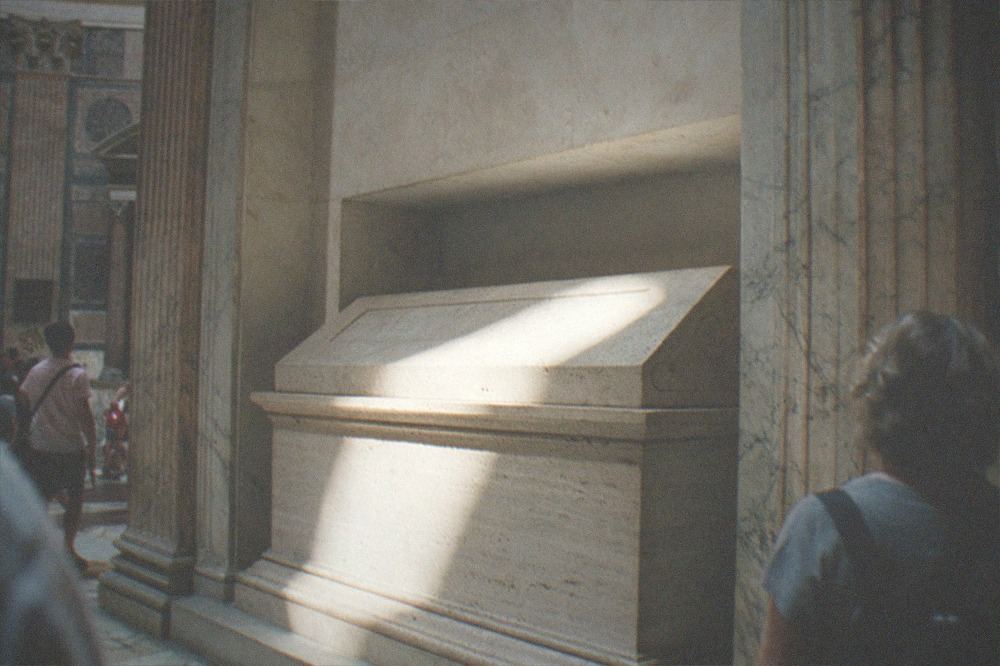
Baldassare Peruzzi, the Sienese architect who worked on St Peter's after Raphael's death, lies in the same niche, a reminder that the Pantheon functioned for centuries as a burial place for artists and architects rather than popes. The popes, by and large, went to St Peter's or to their family churches. The Pantheon's dead are a more secular crowd. This stop sits on a free walking route, Bilingual Center Walk, 2 Hours 15.
The largest and most conspicuous tombs are not Renaissance at all. After Italy's unification, the Pantheon was designated the resting place of the country's kings. Vittorio Emanuele II, the first king of unified Italy, was buried there, and his son Umberto I followed after his assassination in Monza. Umberto's wife, Queen Margherita, lies beside him. Their tombs dominate the apse area behind the altar, guarded by volunteers from patriotic organisations, and they are the reason the building carries the ceremonial title of church of the kings of Italy.
Here is the full list of what you are actually looking at, so the visit does not dissolve into marble confusion:
| Tomb in the Pantheon | Who they were | Where to look |
|---|---|---|
| Raphael | Painter, died in Rome | Third niche on the left, inscription by Pietro Bembo |
| Baldassare Peruzzi | Architect of the St Peter's workshop | Same niche as Raphael |
| Vittorio Emanuele II | First king of unified Italy | Apse, behind the main altar |
| Umberto I | King of Italy, assassinated in Monza | Apse, beside his father |
| Margherita di Savoia | Queen of Italy | Apse, beside Umberto I |
A useful mental rule for the whole building: if the tomb is quiet, small and set into the wall of the rotunda, it is Renaissance. If it is large, dark and flanked by guards, it is royal.
Can You See Raphael's Tomb For Free?
Yes, in three situations. Entry to the Pantheon is free for anyone under 18, of any nationality; it is free for everyone on the first Sunday of the month, with tickets collected on site; and it is free during Mass and other liturgical activity, when the basilica is open for worship. On all other days for adults, entry is ticketed.
The free routes are verified and worth knowing precisely. The under-18 rule comes from the Ministry of Culture's own concessions page, which states it with no nationality condition: an American, British or Japanese teenager walks in free on exactly the same terms as an Italian one. On the first Sunday of the month, the free ticket is collected in person at the cash desks and the automatic totems at the entrance, not booked online, and the Ministry warns that the free ticket gives no priority access, so you queue with everyone else. Other pages covering the same trip are gathered on Free Things To Do In Rome.
The Mass route is the least known. The Pantheon is a working basilica, and during Mass and other liturgical activity it is open for worship at no charge. Mass is held at 17:00 on Saturdays and on days before holidays, and at 10:30 on Sundays and holidays. Ticket sales stop an hour before each liturgical activity. This is not a loophole to exploit loudly; it is the church functioning as a church. But if your timing lands on a Saturday late afternoon, you may walk into a service with the building fully lit and no ticket at all.
For the rest, the building is open daily 09:00 to 19:00, last entry 18:30, with ticket desks closing at 18:00. Access runs in time slots between 09:00 and 18:00, capped at 1,200 people per slot. A dress code is published: shoulders covered, no shorts or very short skirts, no low-cut or transparent clothing. The Ministry's own page for the monument sets all of this out, and access is only by official ticket bought through the Museiitaliani portal or app, or on site at the desks and totems, which settles the question of third-party resellers. This site does not publish a Pantheon ticket price, because no official page reachable for verification currently states one; the honest line is that it is ticketed for adults outside the free routes above.
Is The Pantheon Worth Visiting If You Came For Michelangelo?
Yes, and for a simple reason: the building outclasses anything built for any single tomb. The Pantheon's dome, an unreinforced concrete span finished under Emperor Hadrian in antiquity, remains the largest of its kind in the world, and the oculus above Raphael's grave is open to the sky. Visitors who arrive disappointed about Michelangelo tend to leave having forgotten him.
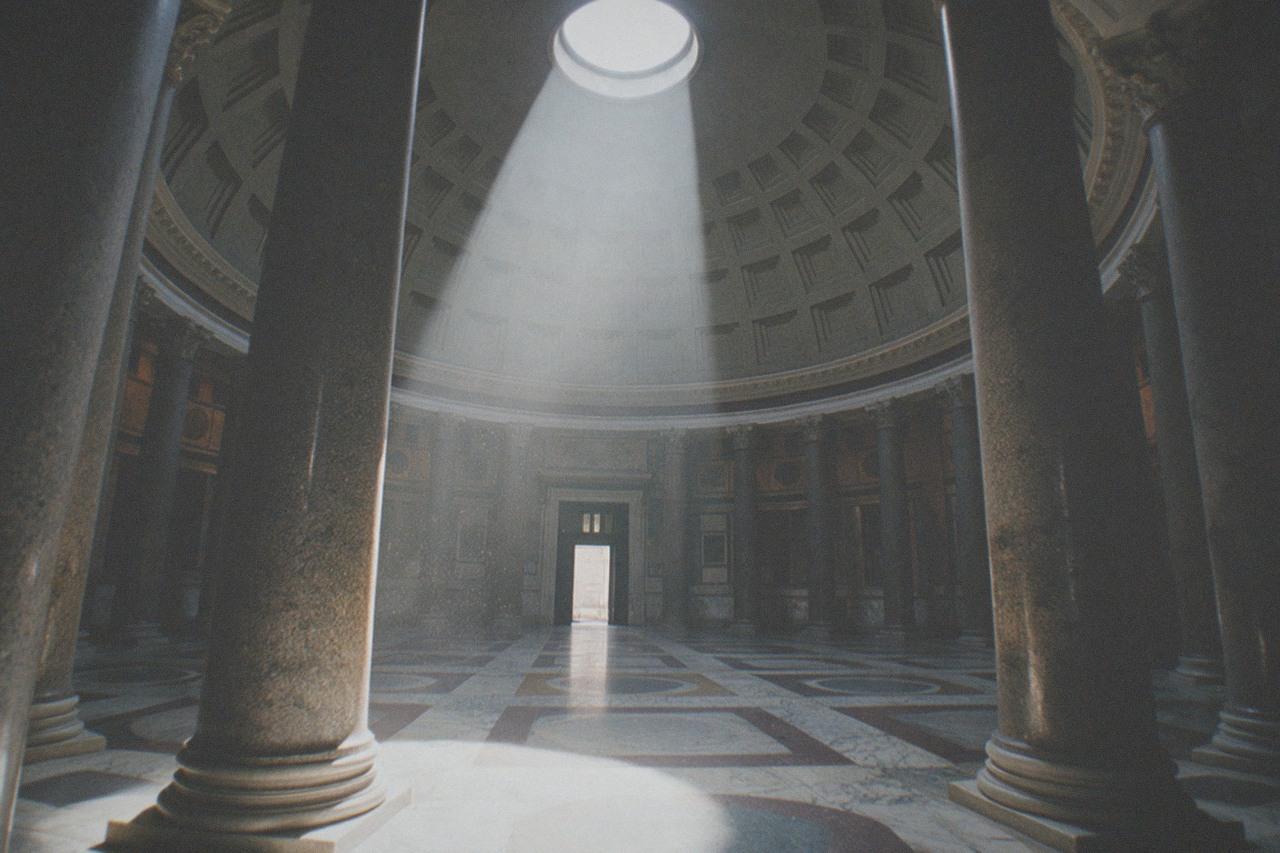
The honest framing is that the Pantheon is not a museum of tombs. It is a piece of engineering that has stood for around nineteen centuries, converted to a church in 609, and still functioning as one. The tombs, Raphael's included, are set into the drum of the rotunda almost as an afterthought to the architecture. The experience that stays with people is the light: the oculus, nine metres across, casts a moving disc of sun across the coffered dome and down the walls, and on rain days the water falls through it onto the sloped marble floor and drains through the original Roman drainage slots.
Michelangelo himself, for what it is worth, admired the building enormously. Renaissance architects treated the Pantheon as a textbook, and the dome of St Peter's that Michelangelo designed is in open conversation with it, wider in span but deliberately lighter in profile. Standing under the Pantheon's dome before climbing to St Peter's, or the other way round, is one of the better free-to-cheap double acts in Rome, since the basilica at St Peter's is free to enter and the Pantheon has the free routes described above.
If the question behind your question is whether Rome repays a trip built around Renaissance art, the answer is plainly yes, and much of it costs nothing. The churches are free, St Peter's is free, and the pay-what-you-want walking tours make even the guided experience effectively free at the point of use. This site's overview of free walking tours in Rome lists them by neighbourhood and language.
What Can You See Around The Pantheon For Free?
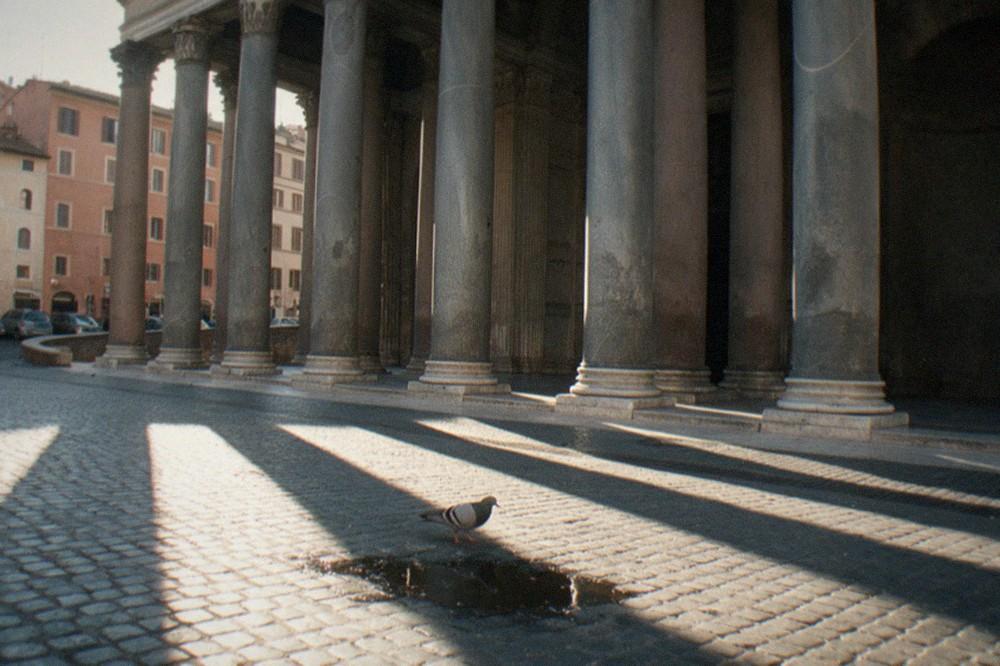
The Pantheon sits in a dense web of free sights: Piazza della Rotonda itself, the Trevi Fountain viewed from the square at any hour, the church of Sant'Ignazio with its famous false dome, and the cobbled lanes of the centro storico between them. All of it is walkable public space, and none of it needs a ticket.
The immediate square, Piazza della Rotonda, is free public space with no ticket, fee, timed entry or crowd cap published for it by the city. From the Pantheon's steps, the historic centre spreads out in every direction. The Trevi Fountain is a few lanes away; since February 2026 the inner perimeter at the basin carries a EUR 2 charge for non-residents during payment hours, but the fountain remains free to see from the square at any hour, and free to everyone after the 22:00 cut-off. The obelisk and palazzi of Piazza di Montecitorio, the columns of Largo di Torre Argentina, and the Renaissance interior of Sant'Ignazio di Loyola, open daily until 23:30 with free entry, all sit inside the same comfortable walking radius.
This is exactly the terrain a good free walk covers. The Bilingual Center Walk, 2 Hours 15, meets at Foro Traiano near the imperial forums and works through the historic centre in English and Spanish, rated 4.82 across 1,529 GuruWalk reviews, with the guiding pay what you want. For a visitor staying near the Pantheon, it is one of the more practical ways to have the neighbourhood explained rather than merely walked.
One planning note that saves real money: the espresso culture around here is part of the free spectacle. An espresso at the bar averaged EUR 1.19 in the province of Rome in 2026, from Ministry price-observatory data analysed by Assoutenti, so standing at the counter with a coffee while the piazza goes about its business costs about the same as the Trevi ticket. Rome's drinking fountains, the cast-iron nasoni, run the same water that reaches Roman homes, with around 2,800 of them mapped across the city, so a refillable bottle does more work in this neighbourhood than in most cities on earth.
Common Questions About Michelangelo And The Pantheon
Is Michelangelo Buried In The Pantheon?
No. Michelangelo died in Rome but is buried in the Basilica di Santa Croce in Florence, in a tomb designed by Giorgio Vasari. The Pantheon's famous Renaissance tomb belongs to the painter Raphael.
Who is buried in the Pantheon?
The painter Raphael, the architect Baldassare Peruzzi, the kings Vittorio Emanuele II and Umberto I, and Queen Margherita. Raphael's tomb, with Pietro Bembo's inscription, is the one most visitors come to see.
Can you get into the Pantheon for free?
Yes, in three verified ways: anyone under 18 of any nationality enters free, everyone enters free on the first Sunday of the month with an on-site ticket, and the basilica is open free of charge during Mass and other liturgical activity.
Where can you see Michelangelo's work in Rome?
The Sistine ceiling and the Last Judgment in the Vatican Museums, the Pietà inside St Peter's Basilica, which is free to enter, and the dome of St Peter's, his design. No Roman church holds his tomb.
Is Raphael's tomb visible with the normal entry?
Yes. The tomb sits in a niche on the left side of the rotunda and is visible on any standard visit, free or ticketed. There is no separate ticket for it.
What is the best free way to see the Pantheon area?
A pay-what-you-want walking tour. The 11 Spots, 2 Hours 45 walk covers the Pantheon with the Trevi Fountain and the centro storico, rated 4.95 across 6,498 GuruWalk reviews, and every walk on this site is a real GuruWalk listing run by an independent local guide.