What Is A Typical Budget For A Trip To Rome?
A realistic Rome trip budget built on verified prices: the tourist tax, transport, espresso, attraction tickets, and the pay-what-you-want walks that keep the daily total down.
What Is A Typical Budget For A Trip To Rome?
A realistic mid-range budget runs roughly EUR 90 to EUR 160 per person per day once you add accommodation, the tourist tax, food, transport and a paid sight or two, while a disciplined budget traveller can hold the line near EUR 55 to EUR 80 by leaning on Rome's genuinely free layer: churches, squares, viewpoints, the nasoni drinking fountains, and pay-what-you-want walking tours. The spread is wide because Rome's pricing changed sharply in 2026, and most older guides understate it.
The honest starting point is that Rome is no longer a city where the sights are quietly free. Since 2 February 2026 the Trevi Fountain charges non-residents EUR 2 to enter the inner perimeter at the basin, payable 09:00 to 22:00, and the fountain stays free to see from the square at any hour. The city's civic museums went free for residents of Rome and the Città Metropolitana on 1 February 2026 while several previously free sites moved to paid for everyone else. Rome recorded 22,965,222 arrivals and 52,920,135 overnight stays in 2025, an average stay of 2.3 nights, and the pricing follows that volume. A free walk covers this ground: 11 Spots, 2 Hours 45.
None of this makes Rome expensive by the standards of northern Europe. It makes Rome a city where the difference between a EUR 60 day and a EUR 160 day is almost entirely planning. This page breaks the budget into its real parts, using prices checked against official sources rather than the recycled figures that circulate in older listicles, and shows where the free layer does the heavy lifting.
The single biggest lever is the pay-what-you-want walking tour. Every walk in this site's directory is a real GuruWalk listing, run by an independent local guide, free to book and tipped at the end. GuruWalk's own Rome guidance puts typical tips at 10 to 20 euros per person, with some walkers leaving up to 50. That is a guided two to three hours of the historic centre for the price of a restaurant main course, and it anchors the budget version of this city.
How Much Does Accommodation And The Tourist Tax Cost?
The nightly tourist tax adds EUR 3.50 to EUR 10 per person per night depending on the category of your accommodation, capped at 10 nights in the same structure, and it is charged on top of the room rate: EUR 6 at a 3-star hotel or B&B, EUR 7.50 at a 4-star, EUR 10 at a 5-star, EUR 3.50 at a hostel. Minors under ten, hostel guests in youth hostels, patients and a carer, and visitors with severe disability plus a carer are exempt.
The rates have been in force since 1 October 2023, approved by Deliberazione di Giunta Capitolina n. 255 of 17 July 2023, and they apply to overnight stays from that date regardless of when the booking was made. The full tariff table is published by Roma Capitale, and the exemptions, including the under-tens and the disability categories, come from the framework regulation of March 2024. Most budget calculators either omit the tax entirely or quote the pre-2023 rates, which understates a week for two people by a meaningful margin.
For the room itself, this site does not publish hotel price ranges, because no verified source for Rome room rates exists in our research record, and a guessed figure is worse than none. What can be said honestly is structural: the tourist tax is per person, not per room, so two people sharing pay it twice, and the 10-night cap only matters on long stays. A couple on a short city break in a 3-star property pays the tax for two people every night, which adds up across a week before a single espresso.
The location of the room matters more to the budget than the room itself. Staying inside the centro storico puts the Pantheon, Piazza Navona, the Trevi Fountain and the Campo de' Fiori within walking distance, which cuts transport to nearly zero. Staying near a metro terminus saves on the room but adds fares and time. The Bilingual Center Walk, 2 Hours 15, which meets at Foro Traiano and covers the historic core in English and Spanish, rated 4.82 across 1,529 GuruWalk reviews, is a good way to audit a central base on your first morning: if you can walk to its meeting point, your transport budget is mostly solved.
What Does Eating And Drinking Cost Each Day?
An espresso at the bar averaged EUR 1.19 in the province of Rome in 2026, from Ministry price-observatory data, and FIPE Roma put the Rome-province average at EUR 1.14 in April 2025, up 6.5 percent on the year before: coffee is the one food price in Rome with a verified figure, and it is cheap. Beyond that, no authoritative source exists for pizza al taglio or a bottle of water, so this site will not invent one.
What the research record does support is the shape of a food day. Stand-up coffee and a cornetto at the bar is the cheapest real breakfast in the city. Lunch can be a walk-around meal of street food, or it can be a seated restaurant lunch, and the gap between those two is one of the largest discretionary swings in the whole budget. Dinner in the centro storico costs more than dinner in Testaccio or Monti for the same food, which is a location premium rather than a quality difference. The honest planning advice is a range, not a promise: budget generously for one good sit-down meal a day and let the other meals be simple, rather than pricing every meal at the cheap end and feeling cheated.
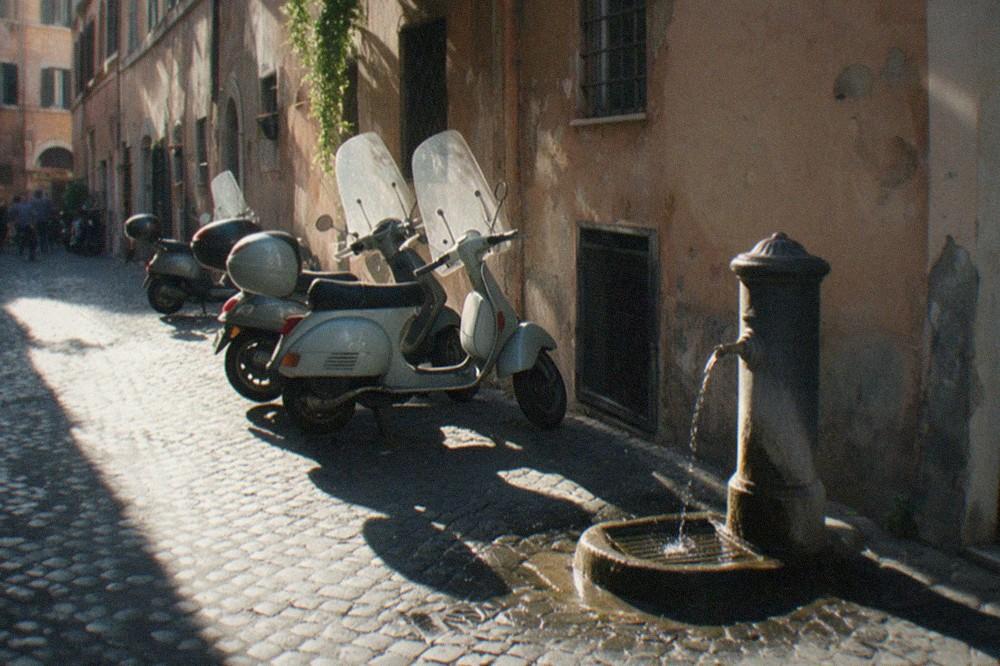
Water is the line item that should be zero. Rome has 2,800 nasoni, the cast-iron drinking fountains geolocated by ACEA's Waidy Wow app, and the water is drinkable, the same water that reaches Roman homes, under annual quality control. The first nasone was installed in 1874, and the city's stated reasons for keeping them running include cutting plastic and giving water to everyone who is thirsty. Travellers posting online in August and September 2026 confirm the fountains work, though some report individual ones running dry, so carry a bottle and treat any single fountain as a bonus rather than a guarantee. A family of four refilling bottles all week saves the price of several meals.
The small unavoidable costs deserve a line of their own. Public toilets at Roma Termini cost EUR 1, and the P.Stop network, including the units at Piazza di Spagna, charges EUR 1 as well. A free walking tour with a food angle can also fold lunch into the sightseeing: the Lunch Small Group, Pasta and Tiramisu walk, rated 4.95 across 716 GuruWalk reviews, is pay what you want for the guiding, though the food itself is a separate out-of-pocket cost, and the same applies to its pizza and gelato sibling. Guiding free does not mean everything on the route is free.
How Much Is Transport In Rome?
Rome's buses and metro are not free: the BIT integrated ticket costs EUR 1.50 and is valid 100 minutes from first validation on buses, trams and urban rail, covering one metro journey, while a Roma 24H pass costs EUR 8.50, 48H EUR 15.00, 72H EUR 22.00 and the weekly CIS EUR 29.00. Children up to 10 travel free with a fare-paying adult.
The pass prices rose on 1 July 2025 under a Regione Lazio tariff decision, so any guide quoting EUR 7 for the 24H is a year out of date. The operator's own ticket pages at ATAC carry the current figures. For most visitors the arithmetic is simple: if you are staying central and walking, two BIT tickets a day beats every pass. If you are crossing the city repeatedly, the 24H pays for itself at six journeys.
Two further facts sharpen the decision. Contactless Tap and Go charges EUR 1.50 per journey and automatically applies the EUR 8.50 daily cap after four taps within 24 hours, so a tapping visitor cannot overpay, which removes the anxiety of choosing a pass in advance. And travelling without a valid ticket costs EUR 104.90 in total, reduced to EUR 54.90 if paid within five days, a fine that would consume two days of a budget trip. Validate every ticket and keep it for the whole journey. Before a big travel day, the national register of transport strikes at the Ministry of Infrastructure and Transport lists proclaimed strikes with dates and sectors, which is worth a minute of checking.
The deeper transport answer is that Rome rewards walking in a way few capitals do. The daytime ZTL bars non-authorised vehicles from the historic centre Monday to Friday 06:30 to 18:00 and Saturday afternoons, and a 30 km/h limit applies across that perimeter, so the centre is quiet, slow and pedestrian-friendly. No official Rome source publishes walking times between landmarks, and this site will not invent them, but the Two-Hour Highlights Walk, rated 4.9 across 722 GuruWalk reviews, starting from Campo de' Fiori, demonstrates the point by covering the essential highlights on foot in two hours. If a free tour can do that, a visitor with a map can walk most of the same ground for the cost of nothing.
Which Attractions Should You Budget For?
Budget for two or three paid sights and let the rest be free: the Colosseum park is the headline cost, the Pantheon is ticketed with free entry on the first Sunday of the month, and the Trevi Fountain charges EUR 2 at the basin but nothing from the square, while St Peter's Basilica, most churches, and the state museums on first Sundays cost nothing. Under-18s of any nationality are free at every state site.
The under-18 rule is the most under-used concession in Italy. The Ministry of Culture states it with no nationality condition: state museums, monuments, galleries and archaeological areas are free for visitors who have not yet turned eighteen. An American, British or Australian 15-year-old is free on the same terms as an Italian one, per the Ministry's concessions page. The famous EUR 2 rate for 18 to 25 year olds, by contrast, is an EU-citizen rate, extended to non-EU citizens only on reciprocity, so a non-EU 22-year-old should not plan around it.
The first Sunday of the month, the Domenica al Museo scheme, is the single best scheduling lever in a budget trip. State sites are free to everyone, but the details bite: the free Colosseum ticket is collected in person, first come, at the ticket office in Piazza del Colosseo, and excludes the arena, the underground and the upper levels; the Galleria Borghese is free but booking is compulsory and a EUR 2 booking fee still applies; the Domus Aurea is closed that day. The Vatican Museums are a different system entirely, free on the last Sunday of the month, 09:00 to 14:00 with last entry 12:30, walk-in with no booking. Our guide to free museum days in Rome walks through every condition. A free walk covers this ground: Colosseum Walk, Bilingual, 1 Hour 45.
The attraction layer is also where the free layer is strongest. St Peter's Basilica is free of charge in the basilica's own words, open 07:00 to 20:00, with the security queue the only cost in time. The Gianicolo viewpoint is published by Roma Capitale as always accessible with free entry. Sant'Ignazio is free and open until 23:30. Four civic museums, including the Museo della Repubblica Romana on the Gianicolo, remain free for everyone. A trip built around these plus two paid sights is not a compromised version of Rome, it is most of Rome. A free walk covers this ground: Small-Group Vatican, 1 Hour 30.
| Attraction | Typical cost for an adult non-resident | Free routes in |
|---|---|---|
| Trevi Fountain, inner perimeter | EUR 2, 09:00 to 22:00 | Visible free from the square at any hour |
| Colosseum park, standard ticket | Ticketed, timed slot, sales open 30 days ahead | First Sunday, in person, first come |
| Pantheon | Ticketed, price on the official page | First Sunday, under-18s, during Mass |
| St Peter's Basilica | Free | Free at all times, dome extra |
| Vatican Museums | Ticketed on open days | Last Sunday of the month, 09:00 to 14:00 |
| Gianicolo viewpoint | Free | Always |
How Much Do Free Walking Tours Actually Cost?
A free walking tour costs nothing to book and typically ends in a tip of 10 to 20 euros per person, which is GuruWalk's own published guidance for its Rome walks, with some walkers leaving up to 50: budget EUR 15 per person per tour and you will be neither stingy nor extravagant. Travellers posting in dated 2025 and 2026 threads report real tips of 10 to 15 euros per person, with couples leaving 30 to 40 total.
This is the line item most budgets get wrong in both directions. Treating the tour as literally free is unfair to the guide, who is a licensed professional working on spec. Treating it as a EUR 50 guided tour overstates it. The honest number sits between, and because you decide after the walk, the tip scales with what the morning was actually worth to you. Our longer treatment of the question, how much to tip on a free walking tour in Rome, works through the reasoning.
The licensing side matters to the budget in a quieter way. Legge 190 of December 2023 created a national register of tourist guides, and from 26 August 2026 registered guides can carry a photo badge with a QR code, so a walker can verify a guide in seconds. Rome's police have been active on the other side of the trade: in September 2025 a man guiding tourists near the Pantheon with a fake badge was fined 4,000 euros, and in November 2025 twenty men selling inflated tickets near St Peter's and the Colosseum drew sanctions exceeding 10,000 euros. Booking through a directory that names the operator, as every listing on Free Things To Do In Rome does, is the cheap insurance against all of that. One of the free walking routes passes through here: Bilingual Center Walk, 2 Hours 15.
What Does A Typical Daily Budget Look Like?
A budget traveller can hold Rome near EUR 55 to EUR 80 a day by staying in a hostel or budget guesthouse, eating one sit-down meal, walking everywhere and using free tours plus free sights; a mid-range traveller lands nearer EUR 90 to EUR 160 with a central 3-star room, a pass-free couple of transport taps and one paid attraction a day. The table below shows how the pieces stack.
| Line item | Budget day | Mid-range day |
|---|---|---|
| Room, per person sharing | EUR 25-45 | EUR 55-90 |
| Tourist tax, 3-star or hostel | EUR 3.50-6.00 | EUR 6.00 |
| Food and coffee | EUR 15-25 | EUR 30-55 |
| Transport, BIT taps | EUR 0-3.00 | EUR 3.00-8.50 |
| Sights | EUR 0, free layer | EUR 10-25 |
| Free walking tour tip | EUR 10-15 | EUR 15-20 |
| Total per person | EUR 55-80 | EUR 90-160 |
Two notes on reading that table honestly. The room figures are planning ranges, not verified prices, because no authoritative source for Rome room rates exists in this site's research record; the tourist tax, transport, coffee and attraction figures are verified and dated to official sources. The free walking tour tip appears in both columns deliberately: it is the one spend that improves a budget day as much as a mid-range one, because it replaces a EUR 30 or 40 paid guided tour with a pay-what-you-want equivalent led by a local.
The final structural point is season. Rome's longest day runs over 15 hours in June against 9 in December, which changes how much of the city you can cover on foot per day, and the heat bulletins of summer 2026, with a level 3 risk day in early September, mean a summer budget should price in more indoor and shaded stops. For the full planning treatment, see our Rome on a budget guide. Whatever the season, the walks below are the cheapest structured sightseeing in the city: each is a GuruWalk listing, free to book, tipped at the end.
Common Questions About A Typical Budget For A Trip To Rome
What Is A Typical Budget For A Trip To Rome?
Plan on EUR 55 to EUR 80 per person per day on a budget, or EUR 90 to EUR 160 mid-range, covering the room, the tourist tax of EUR 3.50 to EUR 10 per night, food, a couple of EUR 1.50 transport tickets and free or low-cost sights. Free walking tours, tipped at 10 to 20 euros per person, replace paid guided tours in either budget.
How much is the tourist tax in Rome?
EUR 3.50 to EUR 10 per person per night depending on accommodation category: EUR 10 at a 5-star hotel, EUR 7.50 at a 4-star, EUR 6 at a 3-star, B&B or guest house category 2, EUR 5 at a 2-star, EUR 4 at a 1-star and EUR 3.50 at a hostel. It is capped at 10 nights in the same structure, and minors under ten are exempt.
Are buses free in Rome for tourists?
No. The BIT ticket costs EUR 1.50 and lasts 100 minutes including one metro journey, and passes run from EUR 8.50 for 24 hours to EUR 29 for the week. Children up to 10 travel free with a fare-paying adult, and contactless Tap and Go caps itself at the EUR 8.50 daily fare after four taps.
Is the Trevi Fountain free?
Seeing it from the square is free at any hour. Entering the inner perimeter at the basin costs non-residents EUR 2 between 09:00 and 22:00, including on the first Sunday of the month. Residents of Rome and the Città Metropolitana, children under 6 and visitors with disabilities enter free.
How much should I tip on a free walking tour in Rome?
GuruWalk's own Rome guidance says 10 to 20 euros per person is typical, with some walkers leaving up to 50. Travellers in recent dated threads report 10 to 15 euros per person, and couples leaving 30 to 40 total. Budget EUR 15 per person and adjust for the guide and the length of the walk.